ADHELIX_
System_Boot_Sequence
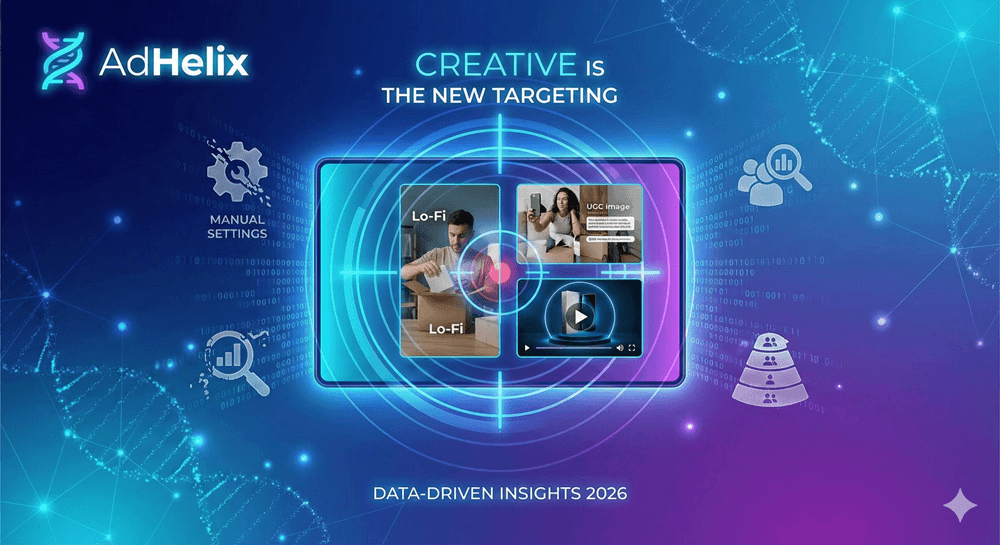
In the high-stakes world of performance marketing, the "Creative" is no longer just a variable—it is the primary driver of algorithmic success. However, most advertisers still treat videos and images as "black boxes." At Adhelix, we argue that to achieve a consistent ROAS > 2, you must stop looking at the ad as a whole and start analyzing it as a sequence of atomic data points.
1. The Psychology of the First 3 Seconds: "The Hook"
Science tells us that the human brain processes visual information in as little as 13 milliseconds. According to the Selective Attention Theory, users filter out irrelevant stimuli almost instantly. If your "Hook" (the first 1–3 seconds) doesn't align with the user's immediate cognitive bias, the rest of your high-production-value video is wasted.
The AdHelix Approach: By tagging specific visual triggers (e.g., "Person pointing at camera" vs. "Product close-up"), we can statistically prove which Hook architecture yields a Thumb-Stop Ratio above 30%.
2. Cognitive Load and the "Body" of the Ad
Once the scroll is stopped, the challenge shifts to Cognitive Load Theory. If the "Body" of your ad is too chaotic, the viewer drops off. If it’s too boring, they lose interest. Scientific studies on Viewthrough Rate (VTR) show that engagement is highest when information is delivered in "chunks."
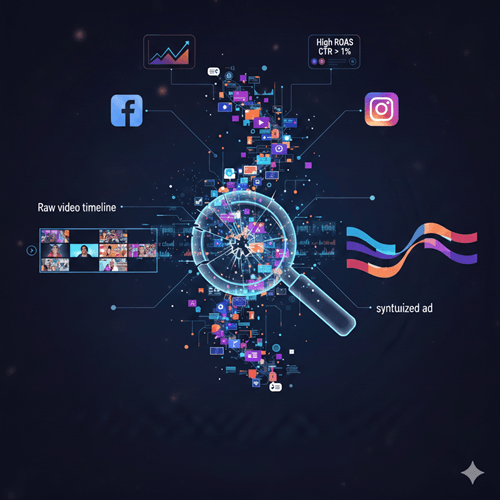
3. The "Frankenstein Effect": Synthetic Winner Creation
The most compelling scientific argument for granular analysis is Multivariate Testing Evolution. Traditional A/B testing (Video A vs. Video B) is inefficient because it doesn't tell you *why* Video A won.
"Is Video A winning because of the music, or because the actor wore a red shirt?"
By deconstructing ads into tags (Music, Color Palette, Pacing, Text Overlays), we apply Regression Analysis to isolate the impact of each element. This allows us to build a "Frankenstein Winner":
4. Combating "Creative Exhaustion" via Pattern Recognition
Ad Fatigue (or Creative Exhaustion) is a documented phenomenon where ad effectiveness plateaus as the frequency increases. Science suggests this is due to Habituation — the brain stops responding to repeated stimuli.
AdHelix uses Pattern Recognition to identify the underlying "DNA" of your successful ads. When a specific creative style stops performing, our data doesn't just tell you "it's dead"; it tells you which specific attribute (e.g., the "Fast-Paced Editing Style") the audience has habituated to, allowing for precise creative pivoting.
Conclusion: From Guesswork to Engineering
The era of "launch and pray" is over. By treating every frame as a data point and every transition as a hypothesis, we turn creative production into a predictable engineering process. **AdHelix** isn't just an analytics tool; it's a microscope for the digital attention economy.
"Technical Note: This creative DNA fragment shows a 94% match with high-converting patterns in the Both ecosystem."